
Jackson Projected Versus Actual Release
Michigan does not give every person one public field named “projected release date.” For an MDOC prisoner, the Offender Tracking Information System uses Earliest Release Date and Maximum Discharge Date. The earliest date is generally when the minimum term has been served and the Michigan Parole Board may obtain jurisdiction. It is an eligibility point. The maximum date is the outer endpoint of the sentence if parole does not occur sooner.
Actual prison release is shown by other fields. Date Paroled together with a PAROLE status establishes that the person left prison for supervised parole. Supervision Discharge Date or a DISCHARGED status records the later end of MDOC jurisdiction. An Earliest Release Date in the past proves neither event because the Board may deny release, defer a decision, or require more release planning.
A pretrial detainee is different. No sentence has set a minimum or maximum term. Bond, a dismissal, a plea, a court order, a detainer, or commitment to another authority can change the path. Jackson County also states that no prospective “out date” is given publicly. A live jail call can address current presence, while a completed event is verified through the Sheriff’s discharge record.
Find a Jackson Projected Release
Begin with the custody system, not the city name. Jackson has two county jail buildings and several MDOC institutions. A person held at Wesley Street or Chanter Road is in county custody. A person at Cooper Street, Cotton, Parnall, Egeler RGC, or Duane Waters is in the state prison system. The county jail does not publish a future release date, and OTIS excludes jail-only sentences.
- Identify the court and authority. Use the 12th District record for misdemeanors and preliminary felony events, then the 4th Circuit record for a felony judgment.
- For an MDOC sentence, open the official OTIS gateway and search by last name or MDOC number.
- Compare the person’s identifiers, sentencing county, offenses, and every sentence block. Similar names are not enough.
- Read Current Status and Assigned Location before reading dates. A new assigned prison is transfer, not release.
- Compare Earliest Release Date, Maximum Discharge Date, Date Paroled, and Supervision Discharge Date. Do not relabel them as one guaranteed date.
- For a county jail sentence, ask the court or Sheriff about the completed record. Do not apply an MDOC calculation to a jail-only term.
The Jackson County released-inmate search sets out the full Sheriff, court, MI-VINE, and OTIS verification chain. When formal proof is needed, request the judgment and the correct agency record instead of relying on a copied search result.
Jackson Release Fields in OTIS
OTIS covers current prisoners, parolees, probationers, and records retained online for three years after supervision discharge. It excludes county jail and city lockup records. The direct search can be narrowed by first name, MDOC number, sex, race, age, or status, but narrowing too soon may hide the correct released record. Search broadly, then verify the record against the sentence.
| OTIS field | What it means | What it does not prove |
|---|---|---|
| Current Status | Prisoner, parolee, probationer, discharged, or another displayed state status | The status of a separate county, federal, or immigration case |
| Assigned Location | Current prison or supervising office | That a changed institution was community release |
| Earliest Release Date | First point when the Board may have jurisdiction under the sentence | A promised gate date |
| Maximum Discharge Date | Outer sentence endpoint shown by MDOC | That the person must remain confined until then |
| Date Paroled | Physical release from prison to parole | End of supervision |
| Supervision Discharge Date | End of the displayed community supervision term | The earlier prison release date |
The MDOC prisoner release-date FAQ shown below explains how minimum and maximum terms frame Michigan release questions.
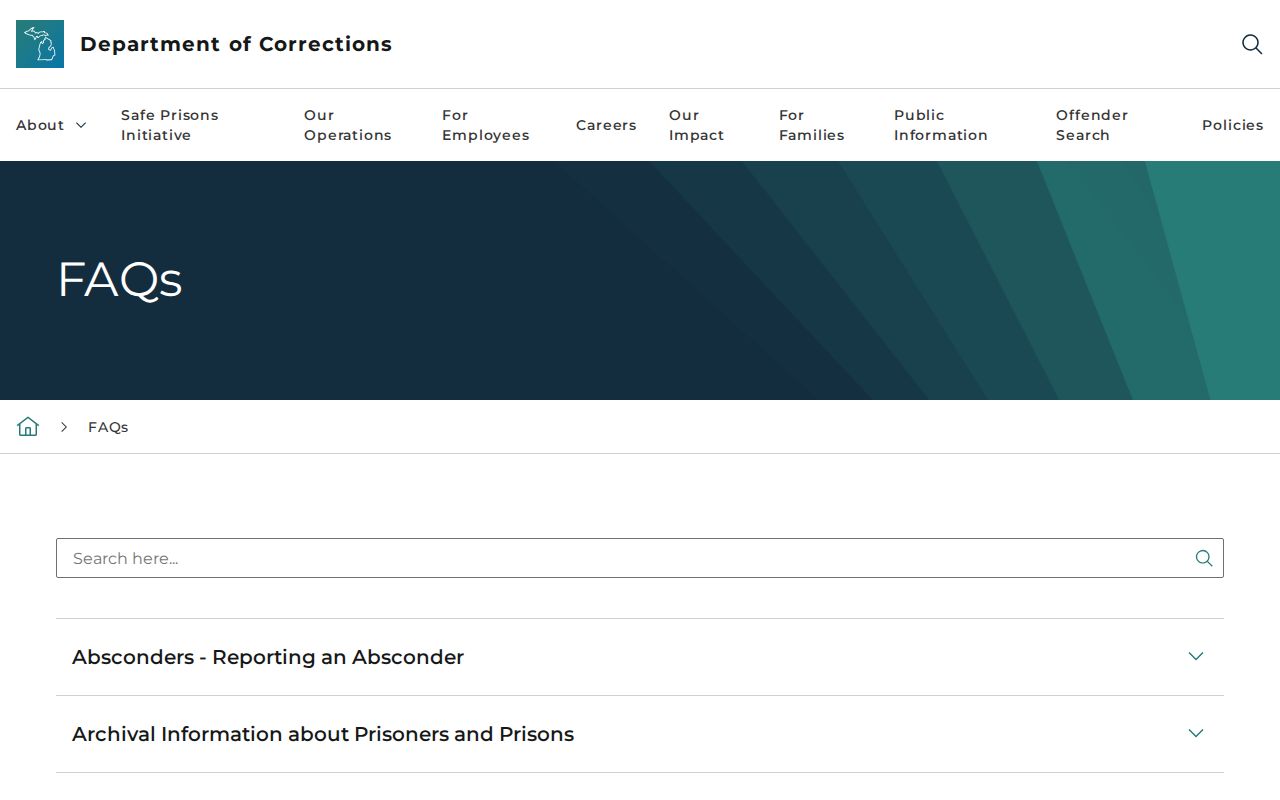
The FAQ reinforces the central point: a minimum-term marker opens a parole decision process, while the maximum is the sentence endpoint if parole does not occur.
Michigan’s Jackson Release-Date Rule
Michigan generally uses indeterminate sentencing. Under MCL 769.8, covered felony judgments carry a minimum term and a legally prescribed maximum. A sentence stated as a range does not promise release at the low number. Reaching the minimum can permit parole consideration, while confinement may continue toward the maximum if parole is not granted.
The common claim that every prisoner serves 85 percent is wrong in Michigan. For covered truth-in-sentencing cases, MDOC explains that the person serves the entire judicial minimum in prison before parole consideration. The broad date categories include assaultive crimes committed on or after December 15, 1998 and other crimes committed on or after December 15, 2000. The accurate shorthand is 100 percent of the minimum before eligibility, not 85 percent of the maximum.
MCL 800.34 addresses the truth-in-sentencing disciplinary-time framework. Misconduct can produce disciplinary time instead of a credit that cuts the judicial minimum. MCL 791.234 governs when the Board obtains jurisdiction and contains special rules tied to offense date, consecutive terms, life sentences, and excluded offenses. Eligibility is not entitlement.
Older cases can involve legacy good time, special good time, or disciplinary credit under MCL 800.33. Those rules cannot be applied from a simple chart without the offense date, the judgment, jail credit, consecutive or concurrent structure, and MDOC’s calculation. Publishing a private estimate as a Jackson projected release date would blur legal rules that depend on the individual sentence.
Parole conditions come later in the sequence. MCL 791.233 governs actual grants and the Board’s required determination, while eligibility statutes govern when review can begin. A lawful grant can still require an approved residence, treatment placement, notices, and release processing. Those steps explain why the decision date, scheduled date, and physical exit date may not match.
Why Jackson Release Dates Change
A release estimate can change because the underlying sentence record changes or because the estimate was never a promised date. Read all sentence blocks. A person can reach the earliest date on one count while another consecutive sentence still requires custody. Likewise, the maximum on a single count may not be the controlling endpoint for the whole case.
| Factor | Effect on the date | Best record to check |
|---|---|---|
| Amended judgment or resentencing | Changes the lawful terms or credit calculation | Court judgment and updated OTIS sentence block |
| Jail or prison credit correction | Moves the computed sentence markers | Court order and MDOC records |
| Consecutive sentences | One term follows another and may control later release | Every judgment and OTIS sentence block |
| Disciplinary time or legacy credit | Affects the applicable sentence class | MDOC calculation and governing offense-date law |
| Parole denial or deferral | Leaves the person confined after eligibility | Board record and Current Status |
| Detainer or receiving authority | Ends one custody episode but can start another | Release entry, receiving agency, and court order |
A favorable Board decision also comes before physical release. The Parole Release Unit must record conditions, plan placement, and coordinate notices. MDOC requires at least 28 days between the decision and gate release. That is why an approved decision should not be reported as the Date Paroled.
Note: A changed assigned institution, especially after Egeler reception processing or health-center treatment, normally signals MDOC transfer rather than release.
Jackson Jail Release-Date Limits
County jail dates follow a different legal and records path. Jackson County’s visitation information says staff do not provide a projected “out date” to the public. A jail sentence can involve credit and any lawfully applicable county good time, but no current Jackson-specific public formula was located. MCL 51.282 authorizes county-sheriff good-time rules in specified circumstances. It does not support inventing a county calculation.
For a completed jail release, use the Jackson County FOIA route to request the Sheriff’s time and manner of discharge. Michigan law requires the jail calendar to record those fields. Ask for the release date and time, release code, code legend, destination, and receiving authority if maintained. A transfer to MDOC, another county, federal custody, or immigration custody is not unrestricted community release.
A MiCOURT case record explains the legal cause. Bond, dismissal, time served, probation, and commitment can appear in the register of actions or order. The operational exit can occur after the court event reaches the jail. The court order and Sheriff movement entry therefore answer related but different questions.
Is a Past Jackson ERD Release?
No. Jackson’s distinctive date problem is the temptation to treat a past Earliest Release Date as proof that a person got out. The ERD identifies a point of possible Parole Board jurisdiction. A denial can leave the ERD in the sentence history while the realistic chance of release moves to a later reconsideration.
Use PAROLE plus Date Paroled to confirm release into supervision. Use DISCHARGED or Supervision Discharge Date to confirm the later end of MDOC jurisdiction. If the record still says PRISONER and names an institution, the person remains confined even when an ERD has passed.
This Michigan rule also explains why the generic 85 percent formula fails. Covered truth-in-sentencing prisoners serve the whole judicial minimum before eligibility. Older sentences and special statutory categories require their own analysis. Only the live judgment, OTIS record, and MDOC calculation can resolve one person’s dates.
Confirm the Jackson Release Event
For a future state-prison event, keep checking Current Status rather than relying on ERD alone. A VINELink inmate search can add an event notification, but the event wording and reporting agency still need review. For a completed MDOC release, compare Date Paroled and supervision status. For a county release, pair the Sheriff discharge entry with the court order.
Formal proof may require a certified judgment, parole document, or discharge certificate. MDOC FOIA can receive a request tied to the six-digit MDOC number. Older public records may no longer appear in OTIS after the three-year post-discharge display window, so an empty search is not proof that no sentence or release existed.
Note: Record the source, retrieval date, exact status wording, assigned location, and each labeled date before drawing a Jackson County release conclusion.